In this article

Key findings
- A 2,450,944-byte x64 SmallDrop wrapper decrypts the 534,016-byte inner agent named ChunkRift.
- Control selects from 64 deterministic DuckDNS candidates on TCP 406; module delivery uses a separate hard-coded HTTP service on TCP 408 in this build.
- Modules are versioned in a Registry cache, then manually mapped into no-window
cmd.exeprocesses. - Public August specimens support a common code lineage. No named operator is attributed.
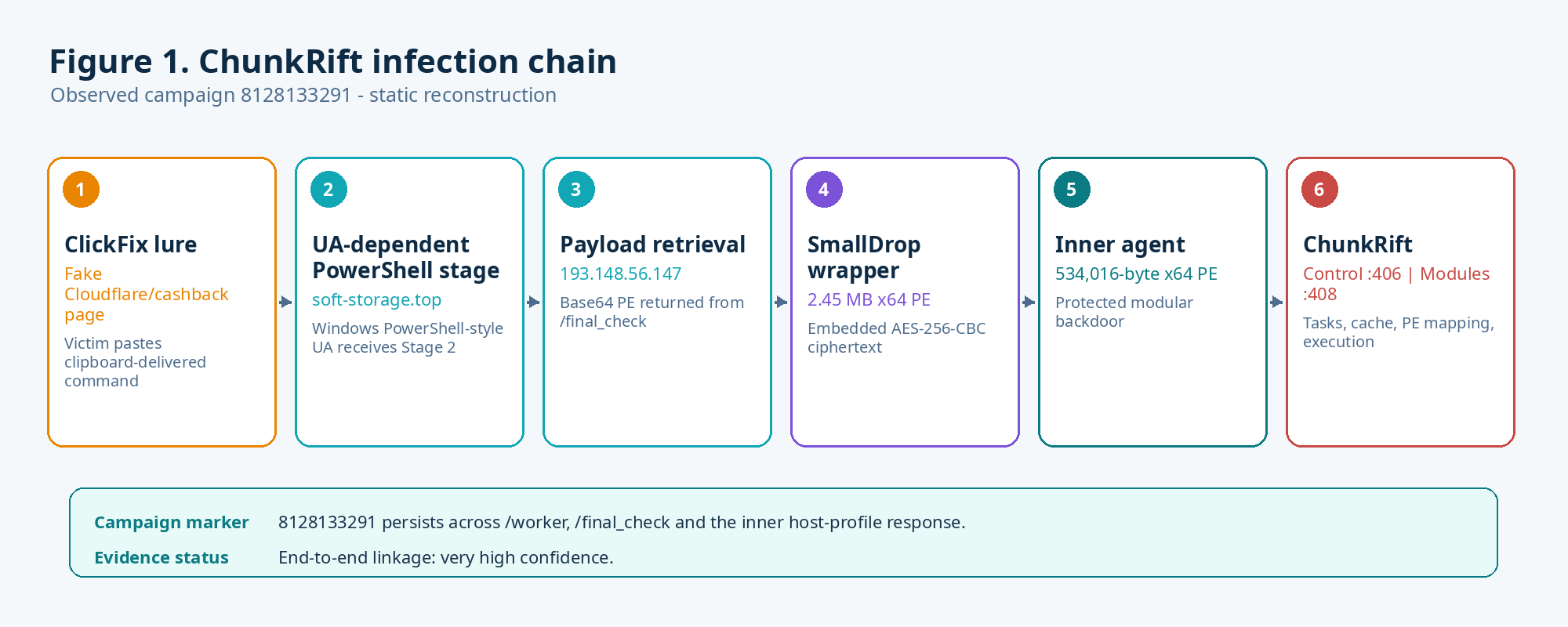
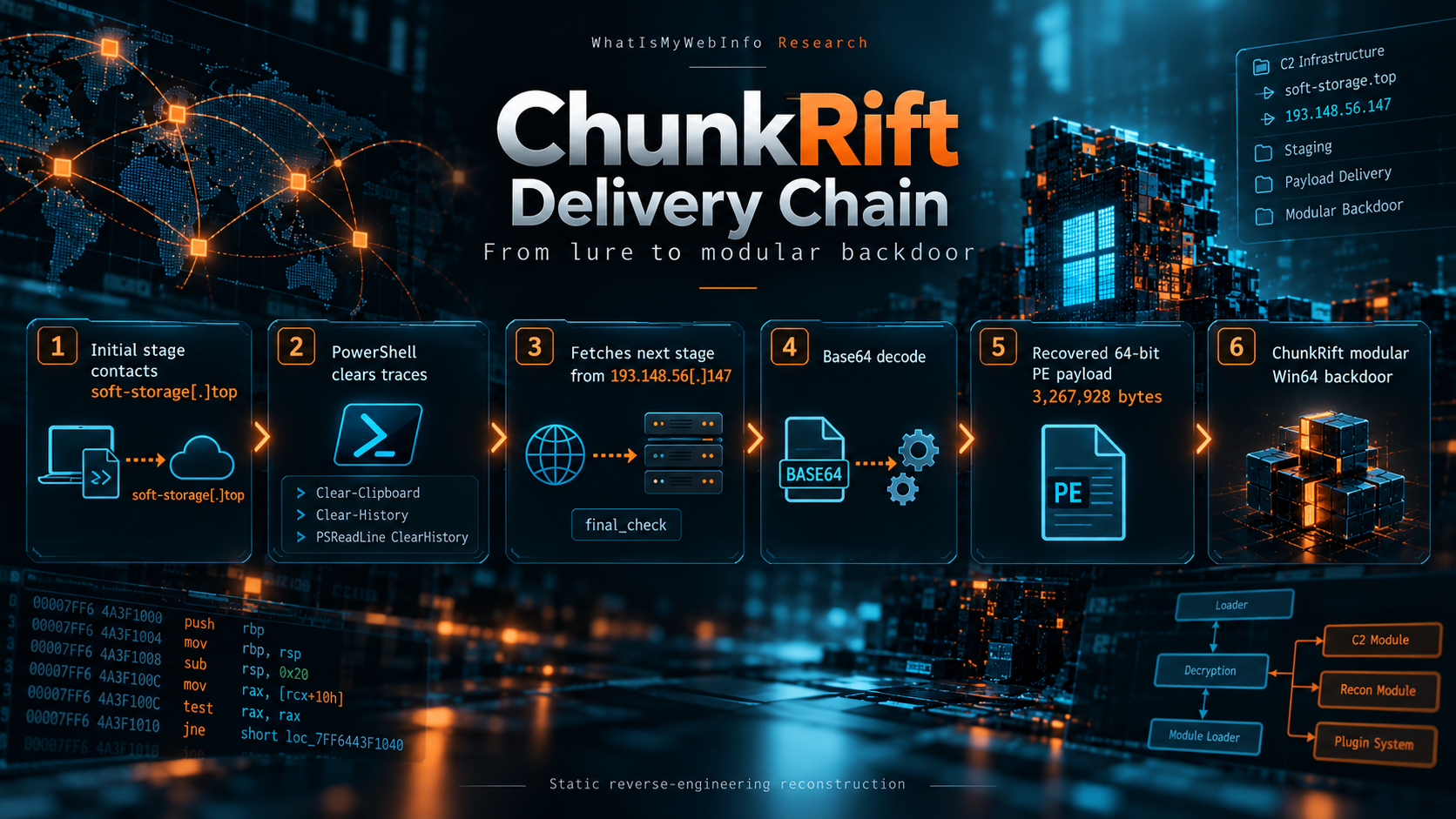
The investigation began upstream of the executable. A ClickFix-style page asked a visitor to paste a command, and the chain ended in a modular Win64 backdoor. We named the recovered inner agent ChunkRift.
Delivery chain
From a pasted command to the inner agent
- A fake Cloudflare/cashback verification page instructed the visitor to paste clipboard-delivered PowerShell.
soft-storage[.]topserved a user-agent-dependent PowerShell stage. The stage cleared the clipboard and PowerShell history artifacts and contained a protection-weakening path when elevated.- It retrieved a Base64-encoded PE from
193.148.56[.]147/final_check?=8128133291/vc. - The decoded 2,450,944-byte x64 SmallDrop wrapper held AES-256-CBC-encrypted payload material.
- Decryption recovered the 534,016-byte x64 ChunkRift inner agent.
The published inner-agent analysis was static. The inner agent was not executed.
Two-channel design
Control and module delivery are separate
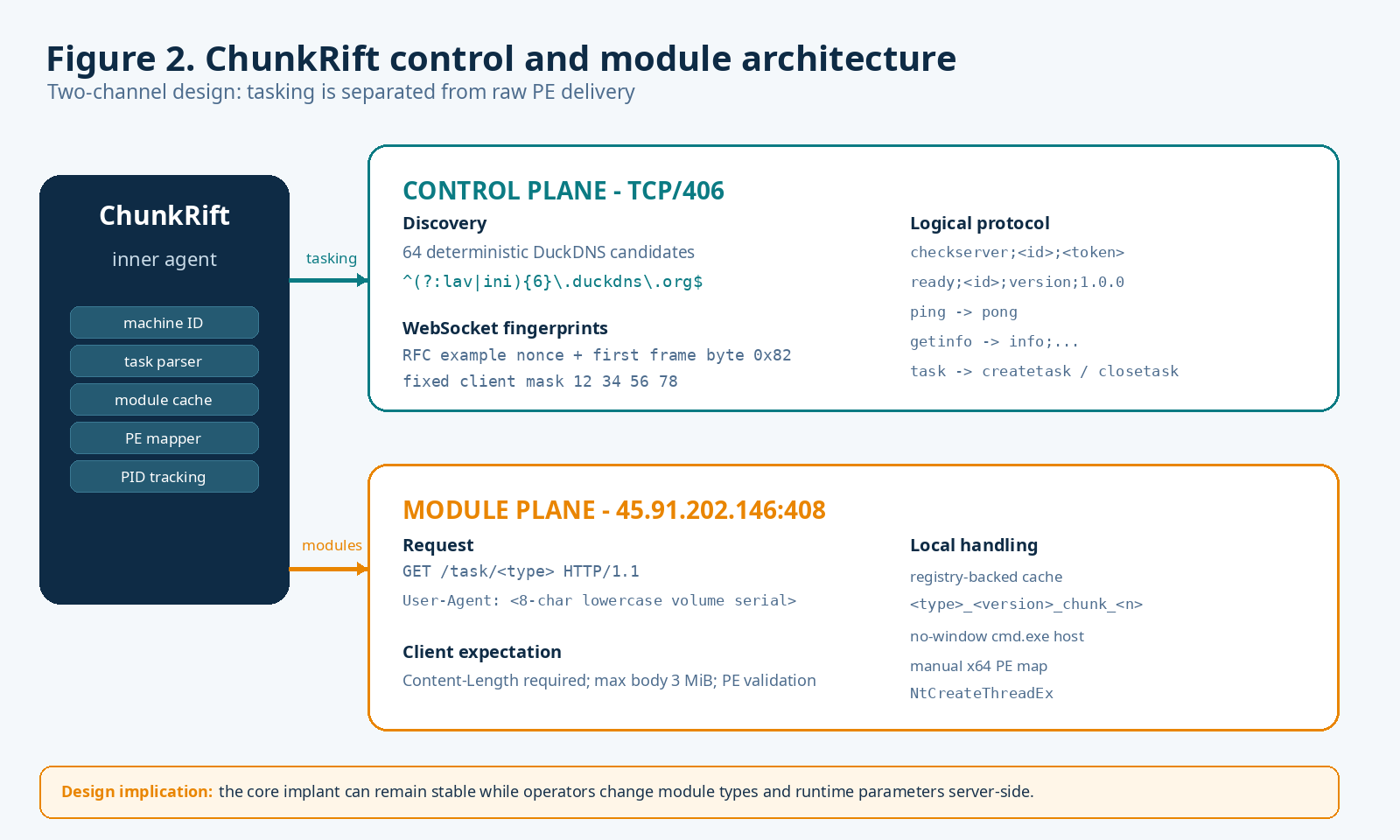
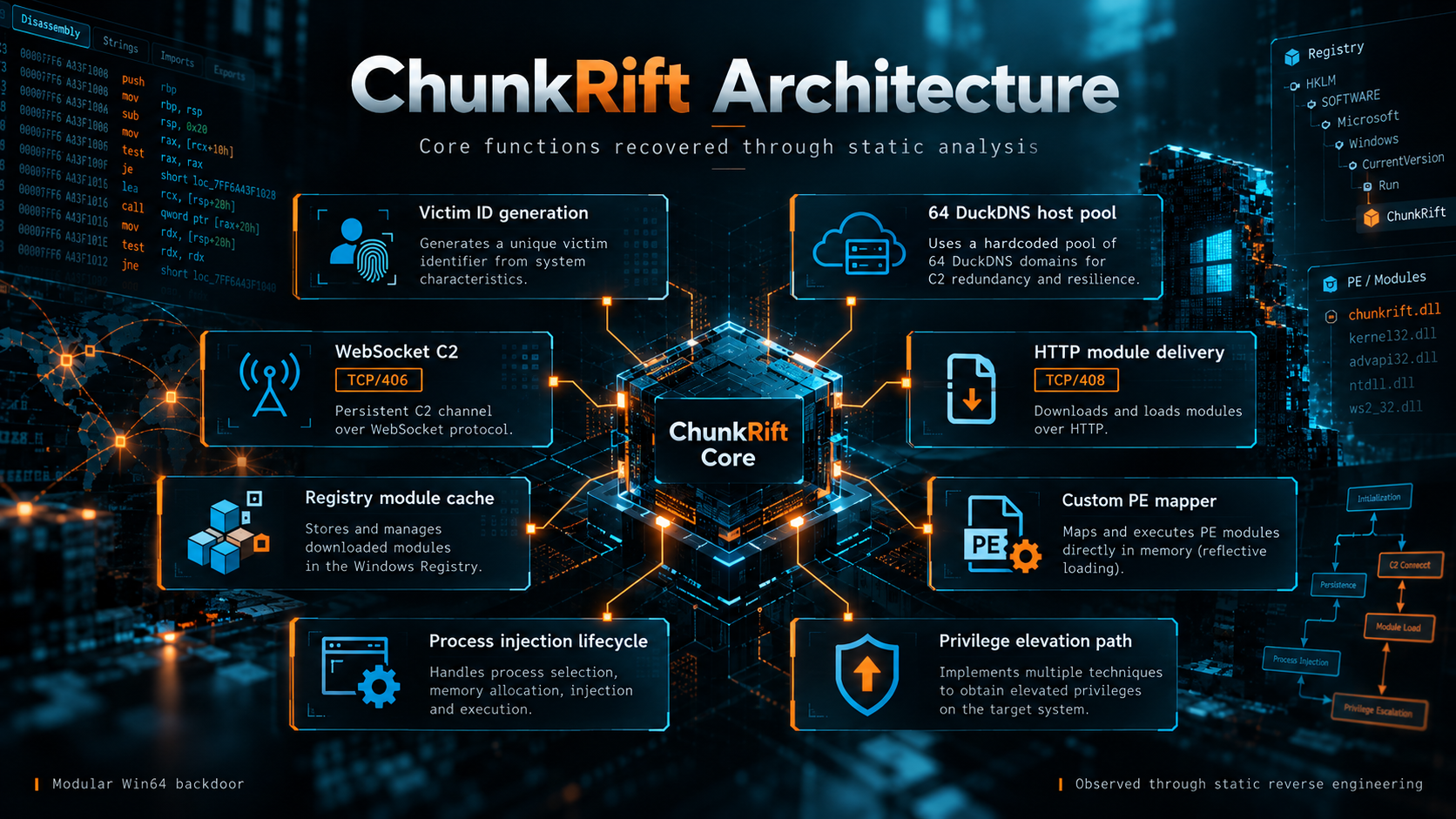
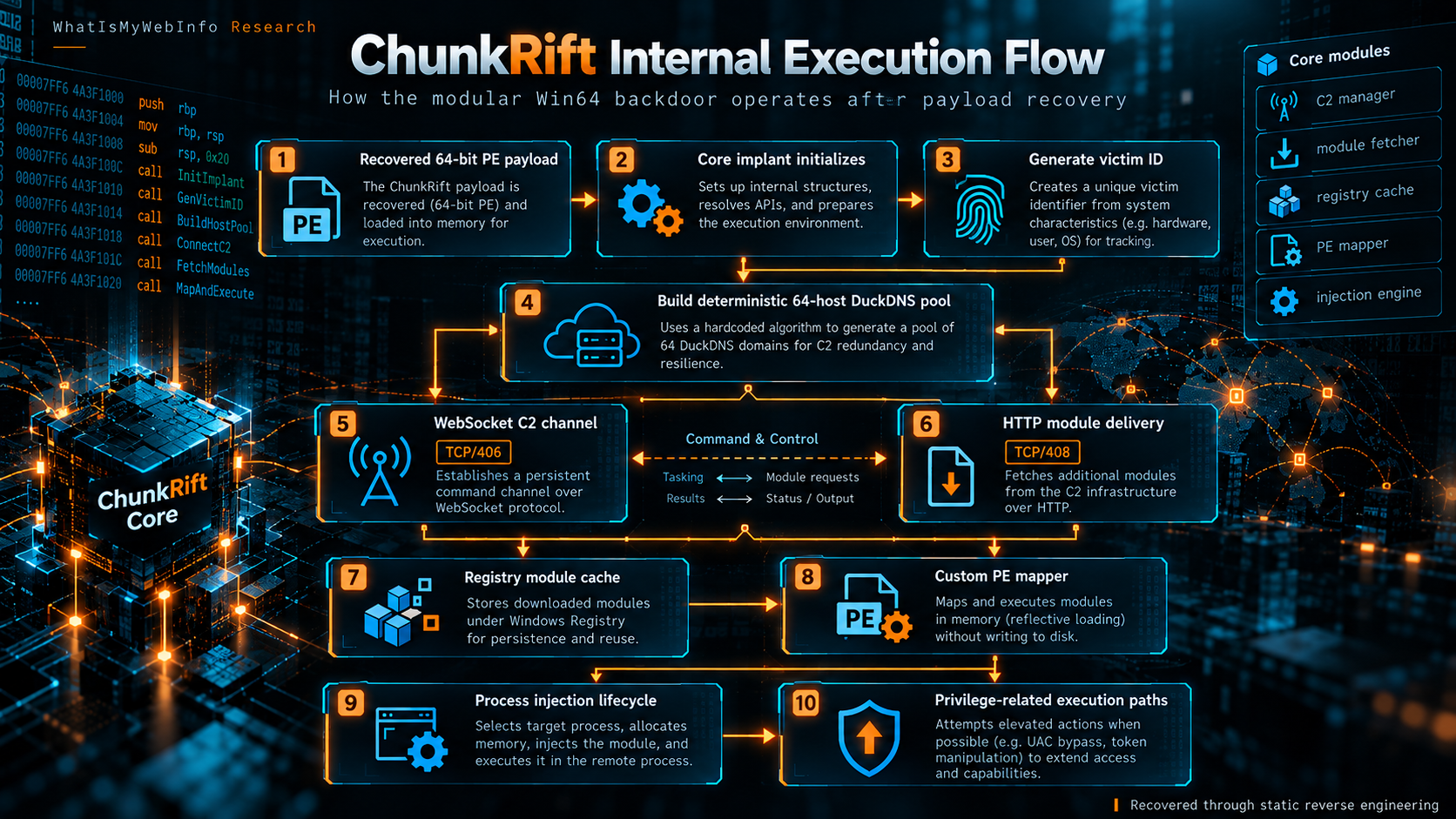
ChunkRift profiles the host, derives a machine ID, parses tasks, and tracks task IDs to process IDs. It uses WebSocket tasking on TCP 406 and a separate HTTP service on TCP 408 for raw PE modules. The core can therefore remain stable while server-side module types and parameters change.
| Component | Recovered role |
|---|---|
| Core implant | Host profiling, machine ID, task parsing and PID tracking |
| Control plane | WebSocket over TCP 406 |
| Module plane | HTTP GET /task/<type> over TCP 408 |
| Module cache | Versioned Registry-backed chunks |
| Execution layer | Custom x64 PE mapping in no-window cmd.exe hosts |
Infrastructure
Sixty-four controller candidates, one configured module service
The control logic generates 64 candidate DuckDNS hostnames matching ^(?:lav|ini){6}\.duckdns\.org$. This reconstructable space is broader than any single hostname observed in one run. In the September build, the module repository is separately hard-coded at 45.91.202[.]146:408, requested with GET /task/<type>.
Static analysis exposes the full candidate space; it does not show that all 64 hosts were active. The full candidate list is included in the archival research package.
Core mechanics
How a task becomes a module process
Tasking, cache lookup, host-process creation, and custom PE mapping form one execution path. The recovered code starts C:\Windows\System32\cmd.exe with CREATE_SUSPENDED | CREATE_NO_WINDOW, resumes the initial thread, and maps the requested module into that process. It uses NtAllocateVirtualMemory, NtWriteVirtualMemory and NtCreateThreadEx; the mapper handles x64 relocations, imports, and TLS callbacks.
From controller task to module entry point
Implementation path reconstructed from the recovered core; a live module catalog was not observed.
- 01WebSocket taskThe core parses
createtaskand tracks task ID to PID. - 02Resolve moduleVersioned cache lookup, or HTTP
GET /task/<type>on TCP 408. - 03Prepare hostStart
cmd.exewithCREATE_SUSPENDED | CREATE_NO_WINDOW; resume its initial thread. - 04Map PEAllocate and write remote memory; apply x64 relocations, imports and TLS callbacks.
- 05Start module
NtCreateThreadExtransfers execution with the operator supplied parameter. - 06Track lifecycleTask/PID association supports subsequent management, including
closetask.
Module system
Registry chunks and remote memory
Downloaded modules are split into versioned REG_BINARY chunks under HKCU\Software\WinRAR\Libs. Temporary chunks become finalized cache entries and can be reassembled for execution. The same task lifecycle connects that cache to a no-window host and an operator-controlled module parameter.
A registry cache feeds a memory mapper
Two linked paths explain why a module may have no standalone executable on disk.
Store and retrieve
- 1HTTP response provides a raw PE module.
- 2Temporary versioned
REG_BINARYchunks are written beneathHKCU\Software\WinRAR\Libs. - 3
*_tempchunk_*entries are promoted to finalized*_chunk_*cache entries. - 4Chunks are reassembled for a later task.
Map and run
- 5No-window
cmd.exebecomes the host process. - 6Memory allocation and writes place the image in the remote process.
- 7The mapper resolves relocations and imports, handles TLS, then starts a remote thread.
- 8The core associates the task with its process ID.
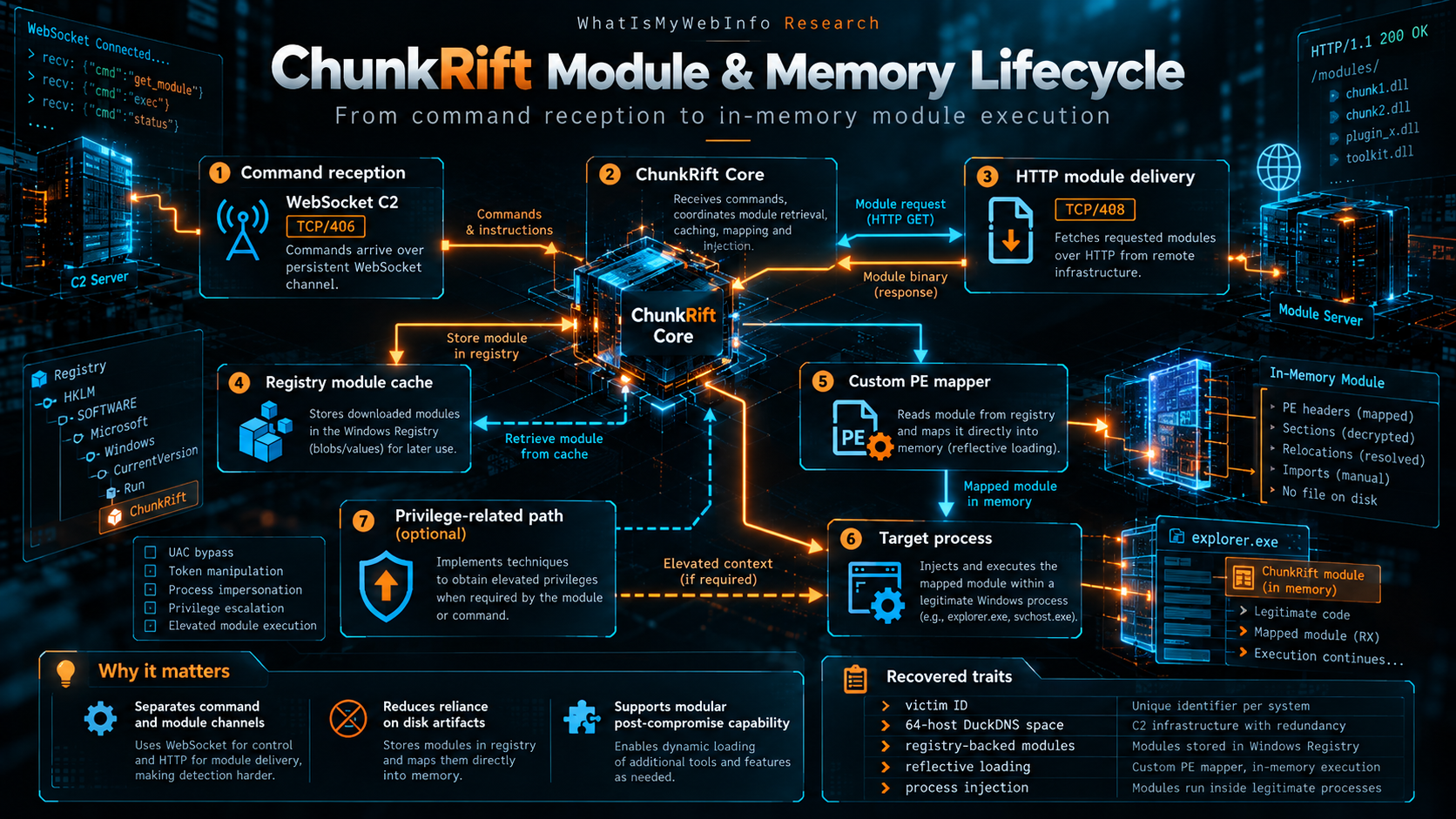
Hunting only for a dropped secondary executable would miss this design. The Registry entries, process creation, remote memory writes and network request belong to the same chain.
Code lineage
How ChunkRift relates to Dacic labels
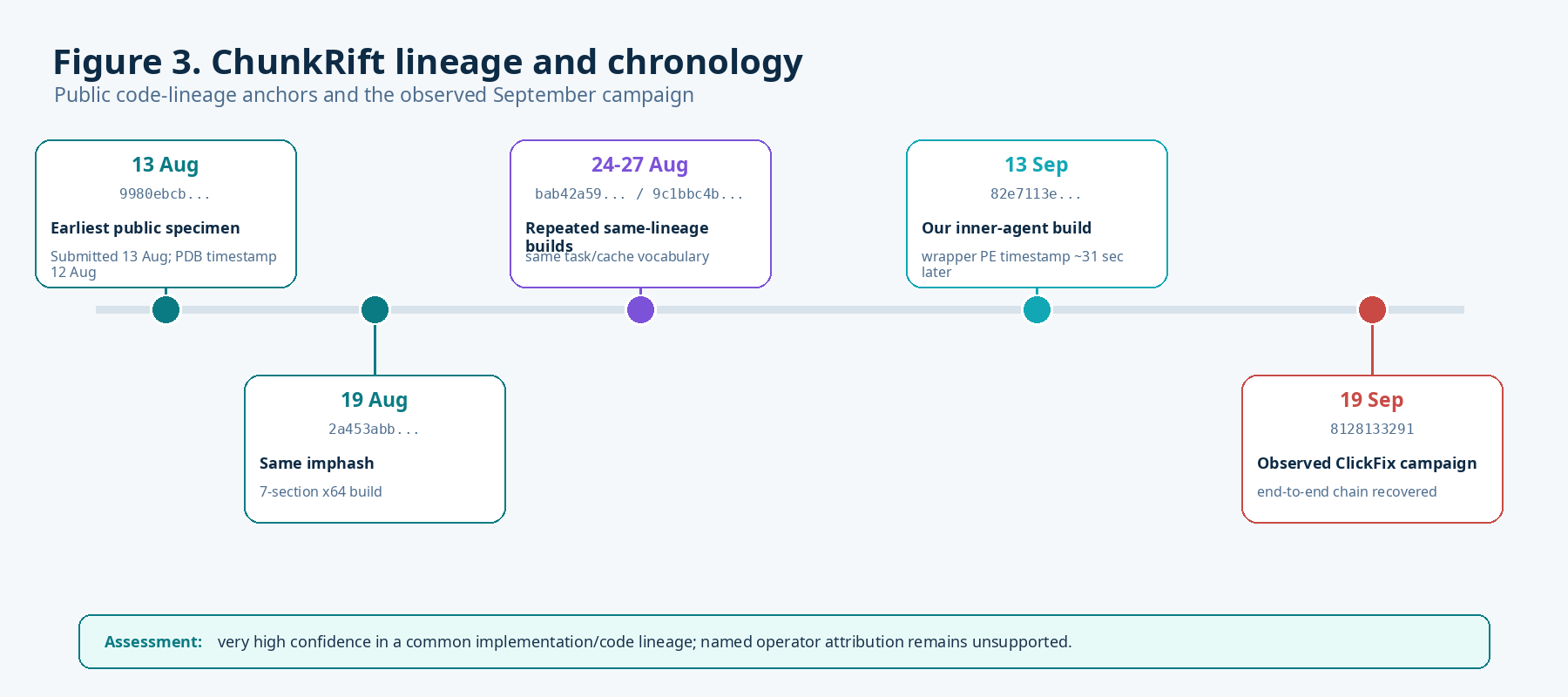
Public August 2026 specimens clustered as Generic.Dacic.18358 share an import hash and distinctive task/cache vocabulary with the September inner agent. Those implementation anchors support a very-high-confidence common code lineage independent of the label. Microsoft uses Dacic as a Defender family name; that naming is retained for discoverability, not treated as actor attribution.
Detection opportunities
Correlate the distinctive sequence
- Investigate a pasted command as the beginning of a chain, including PowerShell staging and history clearing; retain centralized script, process and network telemetry.
- Correlate TCP 406 with the generated DuckDNS namespace, WebSocket first-frame byte
0x82, and fixed client mask12 34 56 78. - Look for the module service on TCP 408,
GET /task/<type>, and an eight-character lowercase hexadecimal User-Agent. - Join
HKCU\Software\WinRAR\Libsvalues matching*_tempchunk_*and*_chunk_*with no-windowcmd.exe, remote writes andNtCreateThreadEx.
The recovered code includes a CMSTPLUA COM elevation implementation using CLSID {3E5FC7F9-9A51-4367-9063-A120244FBEC7}. Its invocation through the protected orchestration path was not independently proven.
Defanged indicators
Artifacts for investigation
| Role | Indicator |
|---|---|
| Lure | captcha-fortnite-cashback[.]info |
| PowerShell stage | soft-storage[.]top |
| Payload retrieval | 193.148.56[.]147 |
| Module service | 45.91.202[.]146:408 |
| Control | TCP 406 / WebSocket; 64 candidate DuckDNS hosts |
| Controller cache | HKCU\Software\Microsoft\EventSystem, value System |
| Module cache | HKCU\Software\WinRAR\Libs |
Full hashes and the 64-host candidate list are in the research record. These indicators describe the examined campaign and build.
Evidence boundary
Methodology and limits
The analysis used static reverse engineering of recovered components, inner-PE decryption, protocol reconstruction, registry-cache analysis, and custom-loader examination. It separates observed campaign artifacts, code-level implementation and inference.
No reboot-persistence mechanism was proven in the analyzed core. The live server-side module catalog was not observed, so downstream objectives cannot be inferred from this core alone. The inner agent was not executed, and no named threat actor is attributed.
Archival publication
Full technical report
ChunkRift: Technical Analysis and Lineage of a Modular Win64 Backdoor
WhatIsMyWebInfo Research. Version 1.0 · 20 September 2026 · Zenodo.
Researcher: Josh Grant · ORCID 0009-0003-9022-4410