Sanitized single-case research
A compromised NYTimes Help page: from ClickFix to SilabRAT.
A technical reconstruction of the vacuumtubr campaign, from a trusted Help-page lure through PowerShell persistence, signed-carrier sideloading, HijackLoader and a recovered SilabRAT payload.
A human reconstruction
John only wanted help with his account.
John notices a subscription charge he does not recognize. It is not alarming, but it nags at him enough to want an answer. He opens the legitimate NYTimes Help site, mildly concerned and expecting a routine support page. The familiar address is reassuring.
As he looks for the right contact information, a verification prompt appears. It is clean, direct and neatly explained. His concern gives way to curiosity, then a little reassurance. John might even think, They have tightened security here. Good. An additional check on a Help page feels plausible.
The prompt guides him through each step: open Windows Run, paste text already prepared for him, then press Enter. The unusually specific instructions give him a brief moment of hesitation, but the trusted address and polished presentation make the request feel legitimate. Nothing asks him to evaluate code. Every action is presented as a small part of reaching the answer he came for, and John follows the steps exactly as they appear.
The page then gives John the information he needs. He contacts support and the issue is handled. Relief replaces the earlier concern. He closes the tab and returns to his day, unaware that the computer has interpreted his helpful-looking instruction in an entirely different way.
John's visible task was over. Windows had only just begun.
Behind the closed tab, the copied instruction had opened a path into the computer and arranged for hidden access to return regularly. What looked like a brief verification step had left something designed to stay.
The recovered malware was built to look for saved logins, browser data and session cookies, cryptocurrency wallet information, files and anything copied to the clipboard. It could also record the screen, capture keystrokes and allow remote control of the device while John carried on with an otherwise ordinary day.
Those are not abstract pieces of data. A browser session can open personal email, photographs, private messages, work accounts and the services that hold a person's daily life together. An email login can become the reset key for many other accounts. A cryptocurrency wallet may hold years of savings. Criminals can sell collections of stolen logins and cookies, take over accounts, impersonate the owner, commit fraud or use a trusted account to reach family, colleagues and customers.
By the time reverse engineering began, the malicious kit was no longer available from the observed NYTimes Help-page location. That is consistent with a rapid removal by the site operator, although the retained evidence cannot establish who removed it or the exact removal time.
The important conclusion is not that someone failed a test. The lure was designed by people to turn an ordinary need for help into a dangerous action, then hide the consequences beneath several technical layers. The technical analysis below reconstructs the recovered chain.
One ordinary-looking instruction quietly opened the door to a hidden compromise.
After the copied command
From one instruction to a recovered RAT.
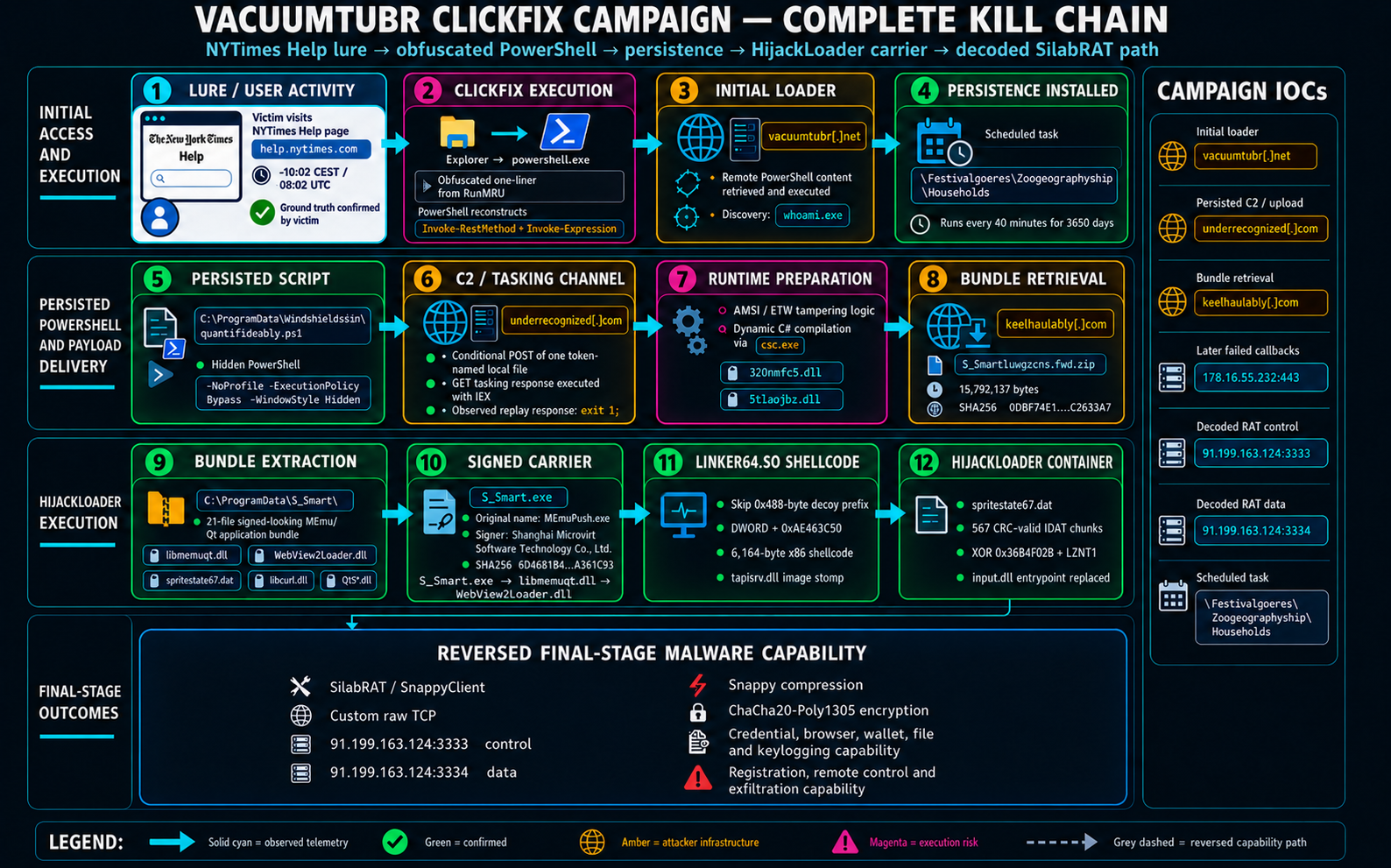
The first command did not deliver the final malware in one step. It opened a sequence of staging, recurring execution, bundle retrieval, side-loading and shellcode recovery. The infographic follows that sequence from the browser handoff to SilabRAT. Public infrastructure is defanged in the tables below.
At the end of the chain
SilabRAT revealed what the operation was built to make possible.
At the far end of the loader sequence, static analysis of the recovered SilabRAT sample exposed the capability set, configuration material and embedded endpoint strings below.
Recovered through reverse engineering
- Chromium credential, cookie and app-bound encryption access
- Keylogging, clipboard monitoring and screen capture
- TightVNC or RFB remote desktop capability
- File discovery, archiving, upload and download
- Shell and process creation plus follow-on payload delivery
- Wallet discovery, persistence and UAC-related functions
- Control and data channels at 91.199.163[.]124:3333 and :3334
Inside the loader
The malware changed form at every layer.
Reaching SilabRAT required more than downloading an executable. Each layer changed the payload's form or the component responsible for running it. Following those transformations made the final sample recoverable.
- PowerShell staging
The persisted script checked for guard processes, contained AMSI and PowerShell ETW tampering logic, compiled helper code through csc.exe, then retrieved S_Smart.txt.
- Bundle preparation
The response was Base64-decoded to a temporary ZIP, 15,792,137 bytes, and exactly 21 top-level files were extracted to C:\ProgramData\S_Smart.
- Signed carrier
S_Smart.exe was a legitimately signed Microvirt MEmu component with original filename MEmuPush.exe. It side-loaded modified libmemuqt.dll and WebView2Loader.dll.
- Shellcode recovery
linker64.so held a decoy prefix and 6,164-byte x86 body. Adding 0xAE463C50 to each DWORD recovered the shellcode.
- HijackLoader container
The shellcode stomped tapisrv.dll and consumed spritestate67.dat. That file used 567 CRC-valid PNG IDAT chunks without a normal PNG signature or IHDR.
- Final payload
The IDAT bodies used marker 0xEA79A5C6, XOR key 0x36B4F02B and LZNT1 compression. HijackLoader selected its ti module, loaded input.dll and recovered the 3,716,808-byte SilabRAT PE.
Static reversing recovered the strings tag=work, buildId=main and%ALLUSERSPROFILE%\Siyuta. The endpoint strings appear in the IOC appendix.
Takeaways
Case characteristics in relation to published ClickFix research.
Since 2024, public reporting has documented fake verification prompts, compromised websites, trusted-brand impersonation, smart-contract staging and many different payload families. This case combined a legitimate Help-page context, a Windows Run handoff, recurring persistence, signed-carrier sideloading, HijackLoader and a recovered SilabRAT payload.
Compromised websites are a recurring arrival route for ClickFix campaigns. Attackers can add or load JavaScript that presents a fake verification overlay, places a command on the clipboard or redirects selected visitors to attacker-controlled infrastructure. Delivered inside a legitimate site, the lure can inherit that site's existing traffic, search visibility and user trust.
A content management system is not required for this technique. It is relevant because a compromised installation can provide a practical place to insert, update and selectively serve the lure. WordPress appears frequently in reporting because of its deployment scale and extensible theme and plugin ecosystem. That broader compromised-site pattern is the context for the WordPress-specific examples below.
Trusted context
A legitimate Help host carried the lure.
The campaign did not depend only on a lookalike domain or malicious attachment. By reversing time, the kit had disappeared from that location.
Durable access
Every 40 minutes for 3,650 days.
The task definition used a 40-minute repetition interval with a 3,650-day duration, configuring recurring execution for approximately ten years.
Recoverable mechanics
The loader exposed several distinct layers.
A signed MEmu carrier, side-loaded DLLs, linker64.so shellcode, image stomping, a PNG-shaped container, HijackLoader and SilabRAT could all be reconstructed.
Collection and transfer
SilabRAT separated control from data transfer.
Reverse engineering exposed separate control and data paths. The data channel at 91.199.163[.]124:3334 was paired with functions targeting browser credentials and cookies, wallets, clipboard content, screenshots and files.
Compared with earlier cases in this research series
These comparisons describe technical patterns. They do not imply common ownership or attribution.
| Case | Execution and staging | Payload path | What differs here |
|---|---|---|---|
| EtherHIDE smart-contract ClickFix | Fake Cloudflare verification, pasted command, JavaScript profiling, then Ethereum or BSC JSON-RPC eth_call staging. | Native loader, browser credential and cookie targeting, plus follow-on .NET execution. | That chain externalized a stage through a smart contract. This case used conventional domains, recurring task persistence and a deeper signed-carrier loader path. |
| pcalua and WebDAV ClickFix | Fake verification, Run dialog, pcalua, PowerShell, CMD, WebDAV and rundll32. | Direct DLL delivery through Windows utilities and WebDAV. | That case emphasized proxy execution and remote DLL delivery. This case adds long-lived persistence, container recovery, image stomping and a recovered RAT. |
| NYTimes Help and vacuumtubr | Trusted Help-page context, Windows Run handoff, scheduled task, polling and bundle retrieval. | Signed MEmu carrier, DLL side-loading, linker64.so shellcode, HijackLoader and recovered SilabRAT. | The distinguishing feature is the combination of trusted context, long-lived persistence and an unusually deep recoverable loader chain. |
Compared with published ClickFix research, 2024 to 2026
The source name in each row links to the original vendor report.
| Published case | Reported pattern | Compared with vacuumtubr |
|---|---|---|
| 2024ClearFake and TA571 | Compromised sites or email lures copied PowerShell commands and delivered loaders, remote-access tools and infostealers. ClearFake also used EtherHiding. | The human-execution bridge is similar. The vacuumtubr case stands out for recurring persistence and the amount of downstream loader behavior that could be reconstructed. |
| 2025WordPress fake reCAPTCHA | Injected or malicious WordPress plugins displayed localized fake verification prompts and copied PowerShell that installed Lumma Stealer. | WordPress supplied a repeatable injection surface across many sites. The current case is notable because the lure appeared in a legitimate NYTimes Help-page context. |
| 2025Lumma through EtherHiding | Compromised websites used smart-contract content and fake verification to launch mshta and deliver Lumma Stealer. | Both begin in a trusted browsing flow. Lumma moved quickly toward a commodity stealer, while this chain persisted PowerShell and passed through a signed carrier and HijackLoader. |
| 2025Booking.com impersonation | Targeted hospitality phishing used a familiar brand and ClickFix to deliver several credential-stealing families. | Brand trust is common to both. This case differs because the malicious instruction appeared in a legitimate Help-page context rather than a lookalike campaign page. |
| 2025Rhadamanthys hidden in PNG data | Fake robot checks and update lures launched mshta, followed by a .NET steganographic loader and payload data hidden in PNG pixels. | Both chains use image-shaped data to conceal later stages. Here, CRC-valid IDAT chunks formed a custom container rather than a normal image carrying hidden pixels. |
| 2026CrashFix and Python RAT | Browser disruption created urgency before living-off-the-land execution and Python RAT delivery. | CrashFix changed the social pressure. Vacuumtubr retained the familiar paste-and-run instruction but added durable task persistence and a layered native loader chain. |
Investigation pivots
Investigation artifacts to search for across the execution chain.
The pivots below connect the browser handoff to PowerShell persistence, loader execution and recovered payload behavior.
Browser to Run
Correlate browsing activity, clipboard instructions, RunMRU writes and Explorer-associated shell launches within a short period.
PowerShell persistence
Alert on hidden or noninteractive PowerShell launched by scheduled tasks, especially when scripts run from unusual ProgramData paths or recur at unexpected intervals.
Dynamic compilation
Review csc.exe spawned from PowerShell, especially when paired with AMSI or ETW manipulation and remote script retrieval.
Signed binary sideloading
Look for a signed MEmu carrier running outside its expected product context with adjacent modified DLLs and data containers.
Container anomalies
Flag PNG-like files made only of CRC-valid IDAT chunks, unusual XOR loops and LZNT1 decompression before image mapping.
Before the IOC appendix
The complete technical chain, condensed.
The story above explains the human impact. This recap condenses the recovered chain and capabilities for readers who want a quick technical reference.
- PowerShell stage
- The recovered script contained scheduled-task creation, recurring execution and remote tasking logic.The stage implemented persistence and a path for retrieving additional instructions.
- Signed carrier and shellcode
- S_Smart.exe side-loaded modified DLLs, while linker64.so yielded a 6,164-byte x86 shellcode body.A legitimately signed carrier helped move execution into the native loader chain.
- Container and final payload
- spritestate67.dat supplied a PNG-shaped HijackLoader container that led to the recovered SilabRAT PE.Reverse engineering exposed the final capability set and embedded endpoint strings.
Defanged appendix
Full public IOC list for this case.
Domains, URLs and public addresses are defanged. The legitimate NYTimes Help host is included only to document initial-access context. No private address, victim identity, endpoint name, username, email address, employer name or internal incident identifier is published.
Network and infrastructure
| Role | Indicator | Confidence |
|---|---|---|
| Lure context | help[.]nytimes[.]com | Legitimate host used for the lure context. Do not block the whole domain. |
| Initial loader | vacuumtubr[.]net | PowerShell loader and staging infrastructure. |
| Persisted C2 | underrecognize[.]com | Polling, response and upload channel. |
| Bundle retrieval | hxxps://keelhaulably[.]com/S_Smart[.]txt | Encoded bundle retrieval path. |
| Recovered RAT control | 91.199.163[.]124:3333 | Recovered during reverse engineering. |
| Recovered RAT data | 91.199.163[.]124:3334 | Recovered during reverse engineering. |
Persistence, paths and filenames
| Type | Value |
|---|---|
| Scheduled task | \Festivalgoeres\Zoogeographyship\Households |
| Task GUID | {DA69E267-E8D4-469E-BD3F-E301E05EAE7D} |
| Persisted script | C:\ProgramData\Windshieldsism\quantifiedably.ps1 |
| Campaign token | C:\ProgramData\Windshieldsism\btYnVMewnMYrWYsmtioQPNQRhuJWYf |
| Deleted result | TaskCreateResult.txt |
| Extracted directory | C:\ProgramData\S_Smart |
| Carrier and loaders | S_Smart.exe, libmemuqt.dll, WebView2Loader.dll, linker64.so |
| Stomped and data files | tapisrv.dll, spritestate67.dat, input.dll |
| Decoded names | SynaEngine32.exe, MediaMonkeyVHelper.exe, xmllite.dll |
| Runtime helpers | 32ommfc5.dll, 5t1aojbz.dll |
Cryptographic hashes
| Artifact | Hash |
|---|---|
| Recovered malicious PowerShell stage | 7cf7c9ba84b2a481367cf49a29e1c154dbc2b3098a46181644959c2405e6a2e7 |
| Original embedded bypass stage | 3591512bfcd58cc56a192b7b2292f2031268299393e53295aa269688aafacd23 |
| S_Smart_payload.zip | 0dbf74e1d02f7f8b43631375e36d86034d160d7e85527ba9f5c1c82a2c2633a7 |
| S_Smart.exe | 6d46b1b4c63ea33f7e1bd5bd2ff915c32bcb0769add87886cfc41e5e9a361c93 |
| Decoded linker64.so shellcode | 9ed5c1ae2a2e5228c3c59059d2118f508c1a65a1d79c92f406b60a798627d919 |
| LZNT1 HijackLoader container | 7138a93550f7398cea9e98923edbdf8848322e55c1a09a123259f7e9d0693843 |
| Final SilabRAT PE | 871b54d2f6c83f33dfe95d2a5d96d223630e6d505acf3419e7fdc364365ae7ce |
| Final SilabRAT PE, SHA-1 | 371b03a81856593417b4f1c01a46c9672718accf |
Scope and privacy
One case now, a comparable series later.
This first paper documents the recent vacuumtubr case. Additional cases can be added later using the same reverse-engineering standard. The public edition intentionally removes victim and organization details, endpoints, usernames, email addresses, internal identifiers, private addresses and organization-specific telemetry.
Public attacker infrastructure, payload paths, filenames, persistence artifacts and cryptographic hashes are retained because they support detection and incident response. No smart-contract address was verified in this case, so none is listed.
FAQ
What this report does and does not claim.
Was the entire New York Times compromised?
This case documents malicious content delivered through a page on the legitimate help.nytimes.com host. It does not establish a broader compromise of the New York Times.
Was this ClickFix or TermFix?
The lure instructed the use of Windows Run, which matches the Run-dialog ClickFix pattern. TermFix is the related variation that tells a person to open PowerShell, Windows Terminal or another shell directly.
What did the reverse engineering establish about SilabRAT?
The final SilabRAT PE was recovered. Static analysis exposed endpoint strings, persistence material, path strings and collection capabilities. This report limits its payload claims to those recovered artifacts.